
Every successful business relies on one critical function that customers rarely notice but always experience— warehousing.
Whether you manufacture products, run an e-commerce store, distribute consumer goods, or manage industrial supplies, efficient warehousing plays a vital role in ensuring products are stored safely, managed accurately, and delivered on time.
Modern warehousing is no longer just about storing goods inside a building. Today, warehouses serve as intelligent logistics hubs where inventory is tracked in real time, orders are processed efficiently, and technology helps businesses optimize costs while improving customer satisfaction.
As global supply chains continue to evolve, businesses require warehousing solutions that are scalable, secure, and strategically located. Choosing the right warehousing partner can significantly improve operational efficiency, reduce transportation costs, and support long-term business growth.
In this comprehensive guide, you’ll learn everything about warehousing—from its meaning and types to modern technologies, operational processes, benefits, challenges, and future trends.
What is Warehousing?
Warehousing is the process of storing goods, raw materials, finished products, or inventory in a dedicated facility before they are distributed, sold, or delivered to customers.
A warehouse acts as a central point in the supply chain where products are received, inspected, organized, stored, managed, picked, packed, and dispatched efficiently.
Unlike traditional storage facilities, modern warehouses use advanced technologies such as Warehouse Management Systems (WMS), barcode scanning, RFID tracking, automation, and inventory analytics to improve accuracy and operational efficiency.
Warehousing helps businesses maintain product availability, prevent stock shortages, minimize losses, and ensure faster order fulfillment.
Let me Simplify for you:
Warehousing ensures that the right product reaches the right customer at the right time while maintaining quality, safety, and cost efficiency.
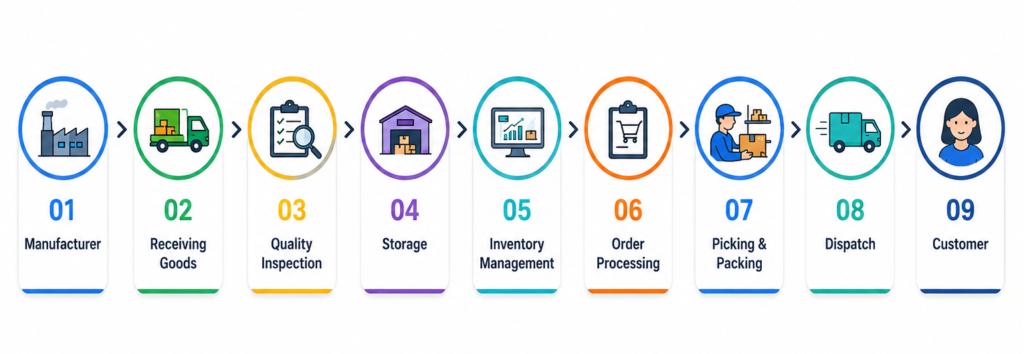
Key Functions of Warehousing
| Function | Purpose |
|---|---|
| Storage | Safe storage of goods |
| Inventory Management | Maintain stock accuracy |
| Order Fulfillment | Faster processing of customer orders |
| Distribution | Smooth movement of products |
| Packaging | Product protection and branding |
| Quality Control | Inspection before dispatch |
| Returns Management | Reverse logistics handling |
Why Modern Warehousing Matters
Without an efficient warehouse, businesses often face delayed deliveries, inventory mismatches, increased costs, and reduced customer satisfaction.
Today’s customers expect:
- Fast delivery
- Accurate orders
- Real-time tracking
- Product availability
- Safe packaging
Modern warehousing addresses these challenges by integrating infrastructure, skilled manpower, and digital technologies into one streamlined operation.
Quick Facts
| Statistic | Value |
|---|---|
| Global Warehousing Market | Multi-billion dollar industry |
| Inventory Accuracy with WMS | Up to 99% |
| Average Order Processing Improvement | 25–40% |
| Warehouses Using Automation | Increasing rapidly worldwide |
Benefits of Professional Warehousing
1. Safe Storage
Modern warehouses are designed with advanced infrastructure, CCTV surveillance, fire protection systems, and controlled storage environments to ensure products remain secure and damage-free.
Businesses dealing with electronics, pharmaceuticals, FMCG, chemicals, or industrial equipment especially benefit from professional storage facilities.
2. Better Inventory Management
Accurate inventory is the backbone of every successful business.
Modern warehouses use:
- Barcode Scanning
- RFID Tracking
- Warehouse Management Systems (WMS)
- Real-Time Inventory Monitoring
These technologies minimize human errors and help maintain inventory accuracy above 99%.
3. Faster Order Fulfillment
Customers expect quick deliveries.
A strategically located warehouse enables businesses to:
- Pick products quickly
- Pack efficiently
- Dispatch orders faster
- Reduce delivery timelines
This results in improved customer satisfaction and repeat business.
4. Reduced Logistics Costs
Professional warehousing helps businesses optimize transportation routes, consolidate shipments, and reduce unnecessary handling costs.
Benefits include:
- Lower fuel expenses
- Fewer delivery delays
- Reduced product damage
- Improved fleet utilization
5. Scalability
As your business grows, your storage requirements also increase.
Professional warehousing allows businesses to expand storage capacity without investing heavily in infrastructure.
This flexibility is particularly valuable during seasonal demand spikes and business expansion.
6. Improved Supply Chain Efficiency
Warehousing acts as a central hub connecting manufacturers, distributors, retailers, and customers.
Efficient warehouse operations help maintain uninterrupted product flow throughout the supply chain.
Warehousing Across Different Industries
Different industries have different warehousing requirements.
| Industry | Warehousing Requirement |
|---|---|
| FMCG | High-volume inventory management |
| Automotive | Spare parts and component storage |
| Pharmaceuticals | Temperature-controlled storage |
| E-commerce | Fast order fulfillment |
| Retail | Seasonal inventory management |
| Engineering | Heavy equipment storage |
| Consumer Goods | Distribution and replenishment |
| Paints & Chemicals | Safe handling and compliance |
Types of Warehouses and Comparison
| Warehouse Type | Ownership | Best For | Storage Duration | Investment |
|---|---|---|---|---|
| Public Warehouse | Third Party | SMEs & Startups | Short/Long Term | Low |
| Private Warehouse | Company Owned | Large Enterprises | Long Term | High |
| Distribution Center | Logistics Provider | Fast Delivery | Very Short | Medium |
| Bonded Warehouse | Government Approved | Import/Export | Until Customs Clearance | Medium |
| Cold Storage | Specialized Operator | Food & Pharma | Depends on Product | High |
| Smart Warehouse | Technology Driven | High Volume Operations | Flexible | High |
Future of Warehousing in India
India’s logistics sector is undergoing a rapid transformation driven by e-commerce growth, manufacturing expansion, digitalization, and government initiatives like the National Logistics Policy and PM Gati Shakti.
According to industry reports, the demand for modern Grade A warehouses is expected to grow significantly over the next decade as businesses prioritize speed, efficiency, and technology-driven operations.
The future warehouse will not just store products—it will act as an intelligent fulfillment center powered by AI, automation, and real-time data.
Conclusion
Warehousing has evolved from simple storage facilities into intelligent logistics hubs that drive business efficiency and customer satisfaction.
From inventory management and order fulfillment to advanced technologies like AI, RFID, and Warehouse Management Systems, modern warehousing plays a critical role in building resilient supply chains.
Choosing the right warehousing partner is not just about finding storage space—it’s about partnering with an organization that understands your business goals and can support your long-term growth.
As supply chains continue to evolve, businesses that invest in modern warehousing solutions will be better positioned to reduce costs, improve service levels, and stay competitive in an increasingly dynamic market.